
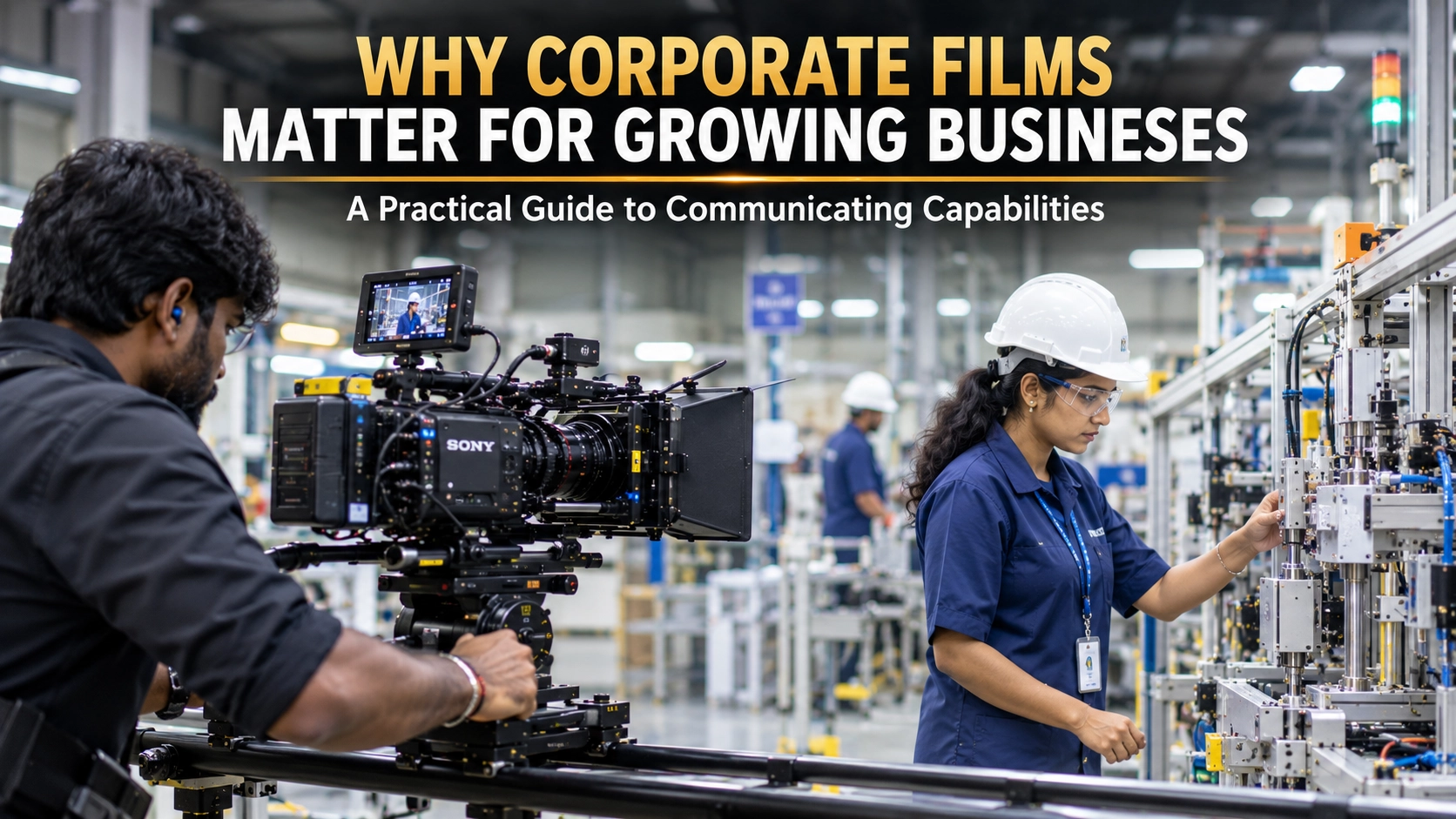
Why Corporate Films Matter For Growing Businesses
A practical guide to communicating your capabilities, people and purpose
Introduction
A company may have strong capabilities, experienced people and a clear vision, yet struggle to communicate its value. Written materials share facts, but some things are easier to understand when seen: the scale of an operation, the care behind a process and the people doing the work.
A corporate film brings these elements into a focused visual story. It helps customers, partners, employees and stakeholders understand the organisation beyond a list of services or claims. Its value depends on a clear purpose, audience and story grounded in the business.

What Is a Corporate Film?
A corporate film communicates an organisation’s identity, capabilities, values, operations or objectives to a defined audience. It may introduce the company, explain how it works, present facilities, feature leadership or show the value it delivers.
A commercial usually focuses on a product, service, campaign or action. A corporate film takes a broader view, helping viewers understand the business behind its offerings. Both can use strong storytelling, but serve different communication needs.
The format should follow the message. One organisation may need a company profile; another may need a manufacturing showcase, leadership message or investor presentation film.
What Can a Corporate Film Communicate?
A corporate film should reflect what the audience needs to understand. Depending on the brief, it may cover:
- Company background and direction: history, purpose, vision, values and priorities.
- Leadership and people: the experience and teams behind the organisation.
- Facilities and operations: workspaces, infrastructure, manufacturing environments and processes.
- Products, services and expertise: what the organisation provides and the capabilities supporting it.
- Quality and responsibility: substantiated quality systems, certifications, safety practices and sustainability initiatives.
- Milestones and progress: developments and business growth supported by approved information.
Not every film needs every subject. Including too much can weaken the story. Select details that matter to the intended viewer.
How Corporate Films Can Support Business Communication
Make the organisation easier to understand. Visuals of facilities, processes, teams and products connect parts of a business, especially when operations are specialised.
Build confidence through evidence. Real locations, authentic processes, knowledgeable employees and accurate information can make a film credible. Avoid exaggerated claims or visuals that misrepresent the organisation.
Create a consistent introduction. A film gives teams a shared way to introduce the organisation in meetings, presentations, exhibitions and digital channels. Adapt it to each audience and setting.
Support sales and business development. Decision-makers may need to understand a company’s capabilities quickly. A focused film introduces the business before discussion; it supports, but does not replace, proposals or direct engagement.
Communicate across markets. A film provides a common introduction across regions or stakeholder groups. Tailor language, subtitles, examples and technical detail.
Corporate Films Across Different Industries
The subject and style should reflect the industry. Manufacturing priorities differ from healthcare or real estate.
Manufacturing and industrial businesses: showcase facilities, production, quality systems, engineering, equipment and teams. Respect safety and confidentiality.
Infrastructure, engineering and construction: present project capabilities, technical expertise, progress, execution and delivery teams. Approve project details and site footage.
Real estate and property development: introduce the development, planning, amenities and developer experience. Distinguish visualisations from completed on-site features.
Healthcare and pharmaceuticals: explain facilities, services, research, manufacturing standards or care environments. Review claims, patient material and regulated information carefully.
Technology and IT: explain software, platforms and technical solutions through demonstrations, animation and accurate visuals.
Education, finance, hospitality and professional services: introduce institutions, service models, expertise, facilities, people and customer experience. Tailor the story to the audience.
When Should a Business Consider Investing in a Corporate Film?
A corporate film is useful when there is a specific communication need and meaningful information to tell the story. Consider one when a business is:
- Entering a new market or introducing capabilities to new customers.
- Approaching corporate clients, institutional buyers, investors or strategic partners.
- Opening a facility, expanding operations or introducing major infrastructure or technology.
- Preparing for exhibitions, trade shows, industry events or business presentations.
- Explaining specialised processes, technical expertise or complex services.
- Communicating its workplace and culture for recruitment or employer branding.
- Replacing an outdated film that no longer reflects its scale, services or direction.
A film is not essential at every stage. Consider the audience, message, material, intended use and budget. A short video or updated presentation may be more suitable.
Where Can Businesses Use a Corporate Film?
Plan distribution before production. Common uses include:
- Company website: introduce the organisation and its capabilities.
- Sales presentations and client meetings: provide a concise overview before discussion.
- Exhibitions and trade shows: communicate capabilities on booth screens, often without sound.
- LinkedIn and other digital channels: share extracts or edited versions with professional audiences.
- Recruitment and internal communication: introduce the workplace, teams, culture and priorities.
One master film may not suit every setting. Plan cut-downs, aspect ratios, subtitles and sound-off versions in the original brief.
What Makes an Effective Corporate Film?
Start with one clear objective. Decide whether the film should introduce the company, demonstrate a facility, explain a process or support a business conversation.
Understand the audience. A procurement team needs different information from an employee or investor. Define who will watch and what they should understand.
Build a credible narrative. Connect the organisation’s purpose with evidence of its capabilities. The script, interviews and visuals should support one message. Check facts, figures, certifications and claims before production.
Use visuals with a reason. Cinematography, lighting, sound, graphics, animation and editing should strengthen the message. Aerial footage can establish scale, close-ups can explain precision and interviews can add a human perspective. Effects should serve the story.
Choose the right production approach. Match the method to the subject, access, schedule and budget. Live-action shows real people and operations; animation can clarify difficult processes. AI-assisted workflows may support selected tasks but must not misrepresent the business.
Plan for platforms. Decide where the film will appear. Websites may need landscape framing; social channels may need shorter or vertical edits. Discuss captions, subtitles, music rights and file specifications in advance.
Preparing for a Corporate Film Production
Good preparation reduces avoidable delays. The organisation and production team should agree on:
- A primary objective, audience and key messages.
- An internal coordinator for access, approvals and communication.
- Locations, permissions and photography restrictions.
- Interview participants, availability and discussion topics.
- Approved company information, product details, figures, certifications and brand assets.
- Operational schedules, safety requirements, protective equipment and confidential areas.
- A filming schedule, shot list, review process and final approver.
In specialised environments, understand site rules and safety constraints before filming.
How to Choose a Corporate Film Production Company
The right partner should understand filmmaking and the business communication objective. Consider:
- Relevant experience: review work related to your industry, subject or production needs.
- Creative direction: ask how the team develops a focused story from the brief.
- Production planning: discuss schedule, locations, crew, interviews, permissions and operational constraints.
- Production quality: review cinematography, sound, editing, graphics and colour in completed work.
- Deliverables and usage: agree on the master film, shorter edits, formats, subtitles, aspect ratios and music.
- Communication and approvals: clarify responsibilities, review stages, revisions, timelines and final approval.
A useful proposal explains its scope and reasoning. Compare inclusions, not just price. Filming days, locations, crew, animation, travel and revisions affect cost.
Corporate Film Production with NexLade
NexLade is a Hyderabad-based corporate and advertising filmmaking company working with businesses across India. We approach corporate films as business communication shaped through filmmaking: understanding what an organisation needs to communicate, then developing a visual narrative around its real capabilities, people, processes and audience.
Depending on the brief, our work can involve creative direction, scripting, planning, live-action filming, animation, AI-assisted workflows and post-production. The right combination depends on the subject, audience and communication objective not on adding techniques for their own sake.
Our work supports company profile films, manufacturing and infrastructure showcases, leadership stories, products and processes, and corporate presentations. Each project begins by identifying what viewers should understand and what evidence can communicate it accurately.
Give Your Business Story the Clarity It Deserves
A corporate film is more than a video about a company. It can make an organisation’s purpose, people and capabilities easier to understand. With a clear objective and a story grounded in real strengths, it can support how the organisation presents itself to customers, partners, employees and other stakeholders.
If your business is planning a new introduction, showcasing its capabilities or updating the way it communicates, explore how NexLade approaches corporate film production.
Latest Posts
© 2026 NexLade Private Limited. All rights reserved.
CIN: U59111TS2026PTC215623